
Kagama Centre Diff leak

This site may earn a commission from merchant affiliate
links, including eBay, Amazon, and others.

HomeHere

Well-known member
Messages
142
Reaction score
202
Points
198
So...
I noticed a heap of aluminium shavings, and alot of oil in the bottom of my Kagama LE today.
On a brief look, I can tell my centre diff has leaked, not a big issue, I needed to do a service anyway.
I pulled it out, and still wasn't quite sure where all the aluminium shavings came from.
There was a screw sticking out from the diff.
And I didn't notice straight away but ....
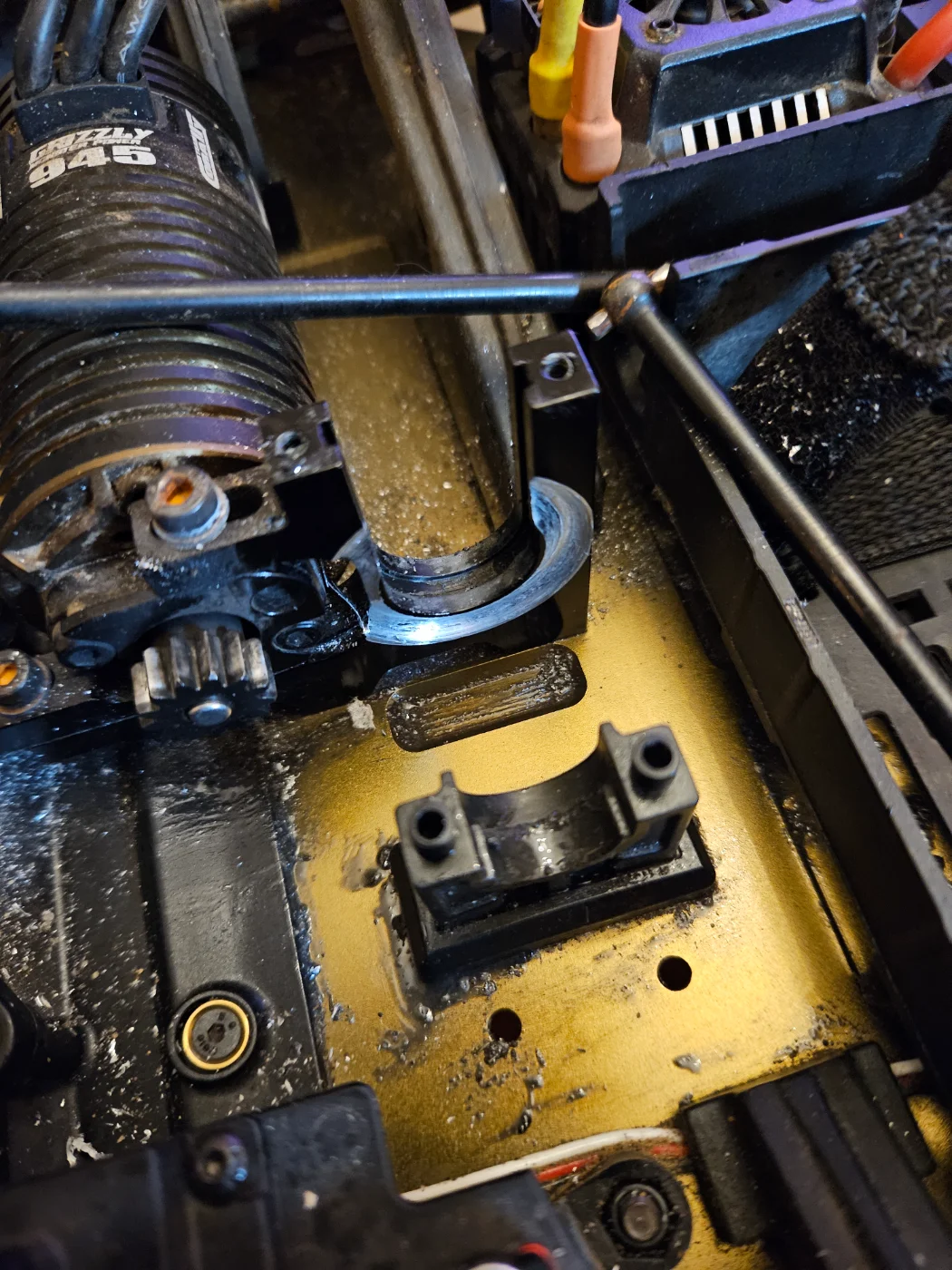
20250728_145312.webp

Seems I've done a bit of damage to the motor mount!
 
I’ve had and have seen it with others on multiple occasions. The center diffs gets very hot, the locktite on the center diff screws dissolves and the screw come unscrewed against the center diff mount.
Thicker oil or more time to let it all cool down after some runtime should do it.
When re-installing the screws, properly clean them before applying the locktite.
 
I use brake cleaner to get all the crap off the screws before applying some blue thread lock , to make sure its double clean I spray the screw again then screw it back in and out to help clean any crap that is in the screw hole.
 
I’ve moved to loctite 248. It is a paste/wax and can still activate with slight oil or low reactive materials like anodized aluminum. The steel screws for the diff mount will activate normal thread lock but 248 is quicker for me and works on wheel hexes as well. Though vibratite vc-3 is the stuff to use there (or in plastic).
 
I’ve had and have seen it with others on multiple occasions. The center diffs gets very hot, the locktite on the center diff screws dissolves and the screw come unscrewed against the center diff mount.
Thicker oil or more time to let it all cool down after some runtime should do it.
When re-installing the screws, properly clean them before applying the locktite.
Locktite #243 is rated for up to 360F so if it's softening I think maybe you have a bigger problem to look into. Even #242 is rated for up to 300F and the diff should only be getting up to 180F max.

I've found that brake cleaner will not dissolve silicone oil but acetone does (get nail polish remover it's cheaper than the stuff from the hardware store but contains a bitterant which won't affect this use case). What I do is leave one screw on each side in the diff after reassembly and then clean the other three holes with acetone and a thick dental brush, then wick out the acetone with a bit of rolled up paper towel and let it dry for 10 minutes. then I replace the screws and remove the last pair and do that hole the same way. Then threadlock everything.

I use a cheap m3 thread cutting die to clean old threadlock crust off the screws. I ordered the cheapest crappiest die I could find and then ran a grade 12.9 screw through it till it dulled it enough that it wouldn't scrape the black oxide coating off the screws anymore. After loosening it up like this screws thread in freely and it merely scrapes the old threadlock out of the threads.

Trick to get threadlock out of threaded holes: Cut a slot down the side of a grade 12.9 screw with a dremel cutoff wheel, the sharp edges will scrape the crusted threadlock out of the threads and the slot will give it a place to collect. Finish by brushing out the hole with a thick dental brush.
 
Last edited:
So...
I noticed a heap of aluminium shavings, and alot of oil in the bottom of my Kagama LE today.
On a brief look, I can tell my centre diff has leaked, not a big issue, I needed to do a service anyway.
I pulled it out, and still wasn't quite sure where all the aluminium shavings came from.
There was a screw sticking out from the diff.
And I didn't notice straight away but ....

View attachment 9922
Seems I've done a bit of damage to the motor mount!
This marring of the motor mount is a common problem, it occurs with diff issues like this, or if the pinion let's go.

IMO, the diffs need captive locknuts and anti vibration washer on the end of the bolts, effectively sandwiching the spur onto the diff - then this problem goes away.

The diffs do get hot during normal operation and if they constantly diff-out, they get ridiculously hot!

Putting really thick silicone or silicone ear plugs in the centre diff essentially turns it into a spool. This makes the car more prone to wheelie and is harder on the rest of the drive train. It's 6 of 1 and half a dozen of the other.

If people still like the way the rig handles afterwards, then it's an option for those that do.

I still encourage people to exercise caution before using anything other than hand tool friendly blue loctite. Even then, it should be applied sparingly. It gacks everything up, has a tendency to build up and can cause issues - especially on smaller or fine threads.

It's not always possible to apply enough heat to easily disassemble things after the use of Red loctite. Our rigs have composite parts that can literally melt when attempting to get enough heat into the screws to remove them.

Good quality tools make applying enough torque easier and more consistent to do, which is half the battle.

The other half of the battle comes from good design principles, where assemblies are able to utilise enough torque - using bolts with decent thread count and nyloc nuts where applicable - to ensure protection against vibration.

There's the problem - our 1/8th rigs have comparatively small parts which accordingly are held together with small fixings.

Small steel screws into soft alloy threads is always going to be a problem, unless it is mitigated with the appropriate measures.
 
This marring of the motor mount is a common problem, it occurs with diff issues like this, or if the pinion let's go.

IMO, the diffs need captive locknuts and anti vibration washer on the end of the bolts, effectively sandwiching the spur onto the diff - then this problem goes away.

The diffs do get hot during normal operation and if they constantly diff-out, they get ridiculously hot!

Putting really thick silicone or silicone ear plugs in the centre diff essentially turns it into a spool. This makes the car more prone to wheelie and is harder on the rest of the drive train. It's 6 of 1 and half a dozen of the other.

If people still like the way the rig handles afterwards, then it's an option for those that do.

I still encourage people to exercise caution before using anything other than hand tool friendly blue loctite. Even then, it should be applied sparingly. It gacks everything up, has a tendency to build up and can cause issues - especially on smaller or fine threads.

It's not always possible to apply enough heat to easily disassemble things after the use of Red loctite. Our rigs have composite parts that can literally melt when attempting to get enough heat into the screws to remove them.

Good quality tools make applying enough torque easier and more consistent to do, which is half the battle.

The other half of the battle comes from good design principles, where assemblies are able to utilise enough torque - using bolts with decent thread count and nyloc nuts where applicable - to ensure protection against vibration.

There's the problem - our 1/8th rigs have comparatively small parts which accordingly are held together with small fixings.

Small steel screws into soft alloy threads is always going to be a problem, unless it is mitigated with the appropriate measures.
Awesome reply!
Thanks Horatio.
I have 1 mill in the centre diff of my other kagama 6, it seems to work quite well. I've not had any issues with screws or over heating at all.
I would think they Loctite from the factory... I probably should have checked the diff before driving especially for the distance it travelled to get here.
So 1 mill diff oil in the centre, and I e used the blue Loctite to put it back together.
I will see how it goes.
 
Been there got the T-shirt, damage won’t affect usage just looks bad. As for the leaking diff , thicker oil will resolve issue temporarily but not a fix I think why so many corally diffs leak & fail is because there is to much play on outdrive cups, stopping o’ring sealing properly & excessive movement resulting in gears getting chewed up , the cross pin which locks it in place inside the diff needs extra shims which will in turn seal your o’ring better & less chance diff failure imo. I need to remove my centre diff so I’ll maybe pull it apart post pics later when do.

IMG_6062.webp
 
I still encourage people to exercise caution before using anything other than hand tool friendly blue loctite. Even then, it should be applied sparingly. It gacks everything up, has a tendency to build up and can cause issues - especially on smaller or fine threads.

It's not always possible to apply enough heat to easily disassemble things after the use of Red loctite. Our rigs have composite parts that can literally melt when attempting to get enough heat into the screws to remove them.
If you need something stronger than blue but still removable then Permatex orange "medium high" can still be removed with hand tools and moderate heat. Also #648 green retaining compound works for this too, SAB helicopter manuals recommend this for the swashplate balls as these are a high vibration environment where blue may not be enough and loosing a swashplate ball means an out of control flying death machine (no joke a 700 size helicopter is likely to kill you if you are hit by it). Again you will need moderate heat to remove it.

Henkel makes a high temp medium strength blue threadlock, #246 that is good for up to 500F though if the diff is getting that hot you have major problems.
 
Question, wouldn't thin diff oil generate less heat because there would be less friction? Corally manuals actually recommend 10,000cps oil in the center diff for offroad.
 
Question, wouldn't thin diff oil generate less heat because there would be less friction? Corally manuals actually recommend 10,000cps oil in the center diff for offroad.
That's a great question.
Watching YouTube some people use 20mill in the centre diff ... Or an earplug!
I've used 1 mill in a Kagama 6s for sometime. It works great!
Just added 1 mill to the LE ... I am hoping for the same performance.
I tried an ear plug in a 4s Kagama.
That did not go so well 😔
V
 
Question, wouldn't thin diff oil generate less heat because there would be less friction? Corally manuals actually recommend 10,000cps oil in the center diff for offroad.
Not if the diff is continuously diffing-out - the thinner diff oil would actually result in the diff getting hotter.

How hot would depend on how much time the diff spends spinning and how much power is being spun through it.

For bashing, Corally recommend 100,000 in the centre diff for the Kronos XTR.

1000038521.webp
 
On the Asuga XLR the manual recommends 10,000 10,000 7500 for offroad and 30,000 100,000, 20,000 for bashing. What's different about bashing vs offroad that requires thinner diff oil? What even IS the difference between "offroad" and "bashing"?
 
On the Asuga XLR the manual recommends 10,000 10,000 7500 for offroad and 30,000 100,000, 20,000 for bashing. What's different about bashing vs offroad that requires thinner diff oil? What even IS the difference between "offroad" and "bashing"?

Bashing = any meaning you want

I take it to mean driving an RC car without caution. Evidently - even if it means smashing it into things with zero talent. 🤣

By off-road, I take that to mean dirt or bumpy ground racing, within the confines of a track, with more limited space.

This means a significantly different way in which a truggy would be set up, based entirely on the traction levels, how bumpy, how many jumps, how tight the corners are, how long the straights are - etc.

But it's a given that it will likely mean much more conservative use of throttle and the requirement that the truck must be able to turn corners and rotate quickly and efficiently without constantly pointing skywards every time the car is given a squirt. The race is won in the turns.

Front diff

Lighter front diff fluid

More off-power steering
Less on-power steering
Less on-power stability

Thicker front diff fluid

More on-power steering
More on-power stability
Less / smoother off-power steering

Center diff

Lighter center diff fluid

More off-power steering
More on-power rear traction
Less on-power steering
Less acceleration

Thicker center diff fluid

More on-power steering
More acceleration
Less off-power steering
Less on-power rear traction
Rear diff

Lighter rear diff fluid

More traction exiting corner
Less traction in corners
More off-power steering
Less on-power steering

Thicker rear diff fluid

More traction in corners
More on-power steering
Less off-power steering
Less traction exiting corner
 
😂
Great break down of the effectiveness of the diff oils in each stage.
I've not touched the back and rear diffs ...
But 1 mill in the centre, I find works really well for what I do.
Daily, weather permitting up and down the road.
Weekends, when time and weather permits, I use a ramp. Or find natural hills to use as ramps.
When I jump the car off road on natural hills or ramp jump. I call that bashing.
I gotta start a YouTube so I can put my videos up.
Yes I've started recording.
Now gotta learn to edit
😭
 
I love all the posts here with people asking "what even is bashing?"

Being old and coming back into the hobby I've discovered RC is now full of nonsense terminology that's mostly comes from YouTube.

Bashing to me basically means driving your car with fairly reckless abandon right up to the edge and slightly beyond the point of what common sense and physics dictates will result in broken parts. If you get to the end of your battery before you break a part, congratulations, bashing success!

Honestly if you came from the 80s/90s era of Tamiya and Kyosho building kits you drive these things with a lot more mechanical sympathy and understanding than the post Traxxas era kids do.

Don't get me started on "traction roll" we used to call that taking a corner too fast..
 
Last edited:
Bashing = any meaning you want

I take it to mean driving an RC car without caution. Evidently - even if it means smashing it into things with zero talent. 🤣

By off-road, I take that to mean dirt or bumpy ground racing, within the confines of a track, with more limited space.

This means a significantly different way in which a truggy would be set up, based entirely on the traction levels, how bumpy, how many jumps, how tight the corners are, how long the straights are - etc.

But it's a given that it will likely mean much more conservative use of throttle and the requirement that the truck must be able to turn corners and rotate quickly and efficiently without constantly pointing skywards every time the car is given a squirt. The race is won in the turns.

Front diff

Lighter front diff fluid

More off-power steering
Less on-power steering
Less on-power stability

Thicker front diff fluid

More on-power steering
More on-power stability
Less / smoother off-power steering

Center diff

Lighter center diff fluid

More off-power steering
More on-power rear traction
Less on-power steering
Less acceleration

Thicker center diff fluid

More on-power steering
More acceleration
Less off-power steering
Less on-power rear traction
Rear diff

Lighter rear diff fluid

More traction exiting corner
Less traction in corners
More off-power steering
Less on-power steering

Thicker rear diff fluid

More traction in corners
More on-power steering
Less off-power steering
Less traction exiting corner
AHH I see you define bashing much the same way I do 😂
 
Back
Top