
Navigation
Install the app
How to install the app on iOS
Follow along with the video below to see how to install our site as a web app on your home screen.
Note: This feature may not be available in some browsers.
More options
Style variation
You are using an out of date browser. It may not display this or other websites correctly.
You should upgrade or use an alternative browser.
You should upgrade or use an alternative browser.
Kronos XTR screws spin freely
- Thread starter Opua
- Start date
This site may earn a commission from merchant affiliate
links, including eBay, Amazon, and others.
links, including eBay, Amazon, and others.

Sandracer_NL
Well-known member
- Messages
- 377
- Reaction score
- 601
- Points
- 293
- Location
- The Netherlands
- Corally RC's
- Kagama
- Muraco
- Radix
- Spark
Yes, it happens sometimes when you overtighten it. If the screw still holds everything nice and tight in place I’d leave it like it is now or of get a new diff housing.Hi, I noticed that some of the screws holding the rear differential are loose in the plastic. I practically can't tighten them because they spin freely... Has this ever happened to you? What solution could I use?
Or you could try and drill it for a longer screw.

AggyMi
Well-known member
- Messages
- 515
- Reaction score
- 614
- Points
- 248
Sounds like the housing is stripped, one of mine is like that but it still holds reasonably well. If it's not to badly damaged wrap one layer of ptfe tape around the screw for extra bite, do not over tightenHi, I noticed that some of the screws holding the rear differential are loose in the plastic. I practically can't tighten them because they spin freely... Has this ever happened to you? What solution could I use?


Horatio
Well-known member
- Messages
- 2,664
- Reaction score
- 3,536
- Points
- 458
Remove the screws. Get some bicarbonate of soda, fill the stripped out hole with bicarbonate of soda. Then fill the hole with super glue and wait for it to harden.Hi, I noticed that some of the screws holding the rear differential are loose in the plastic. I practically can't tighten them because they spin freely... Has this ever happened to you? What solution could I use?
Drill and tap the hole.
Alternatively - replace the parts that have stripped out. Nylon threads don't last forever.
Horatio
Well-known member
- Messages
- 2,664
- Reaction score
- 3,536
- Points
- 458
Terrible idea.What do you think about the technique of breaking a toothpick and inserting it into the threaded hole?

It might work for dealing with a problematic raw plug when hanging a frame on a wall - but it's not ideal for an RC truck.
Super glue and bicarbonate of soda does work though.
- Thread starter
- #7
Thanks you Horatio, the damaged thread is on the plastic, so redoing the thread on the plastic means screwing the screw in, which will create a new thread without the tapping for threading, right?Drill and tap the hole
Horatio
Well-known member
- Messages
- 2,664
- Reaction score
- 3,536
- Points
- 458
You're welcome. If you use Super glue & bicarb trick - which essentially fills the old hole - you then need to drill an undersized hole and re-tap the hole with a new thread with an actual tap.Thanks you Horatio, the damaged thread is on the plastic, so redoing the thread on the plastic means screwing the screw in, which will create a new thread without the tapping for threading, right?
These are M4x14 and M4x16 CSK bolts, so you would need to drill a 3.3mm hole and then use an M4 tap. If you try cutting it with an actual bolt, you run the risk stripping the Cyanoacrylate repair material.
If you own a metric tap set, and high speed drills, it's a 5 minute job.
If you don't - just buy a replacement part:
C-00180-033

Horatio
Well-known member
- Messages
- 2,664
- Reaction score
- 3,536
- Points
- 458
I've mentioned this elsewhere on the board:
When re-screwing machine screws into nylon/composite material, unless the screws are carefully screwed back into the existing threads, the screws repeatedly cut new threads. This is obviously bad and results in failure of the threads, even if you don't over-tighten things.
So here's 3 tips that really help.
When re-screwing machine screws into nylon/composite material, unless the screws are carefully screwed back into the existing threads, the screws repeatedly cut new threads. This is obviously bad and results in failure of the threads, even if you don't over-tighten things.
So here's 3 tips that really help.
- When lining up a metal bolt into nylon hole, turn the screw counter-clockwise with light pressure, til a 'click' is heard/felt. This indicates the start of the bolt thread lining up with the existing thread in the nylon, saving the nylon part from cross-threading or stripping.
- When metal screws are turned inside an interference fit thread within a nylon part, heat builds rapidly, even when using hand tools. The longer the bolt, the greater the heat generated. So, don't rush. Give the nylon part a chance to cool. The faster the screw is tightened, the softer the nylon gets. Soft threads strip more easily.
- Don't allow thread lock - or screws that have been used previously with threadlock on them - to come into contact with nylon parts. It makes them brittle. Brittle threads strip easily.

Horatio
Well-known member
- Messages
- 2,664
- Reaction score
- 3,536
- Points
- 458
Cheers! When I used to race the old Team Associated TC3 - which had a carbon composite chassis that the front and rear transmissions were bolted into, most of the assembly involved imperial screws into composite.That's an amazing screwing tutorial
Many people experienced stripped threads.
This was also an issue with the Tenth Tech Predator - which also featured a carbon composite monoqocue chassis. The holes were notorious for stripping - and the chassis was eye wateringly expensive to replace!
Cliff Lett from Team Associated detailed the turn counter-clockwise, hear the click - then tighten trick. It works!
And bicarbonate of soda with super glue is a useful life hack for 1001 jobs.
I also use cotton wool and super glue for cupboard door knob/handle repair.
AggyMi
Well-known member
- Messages
- 515
- Reaction score
- 614
- Points
- 248
You have no idea how many things I'm going to put right in my 25 year old caravan this weekend!And bicarbonate of soda with super glue is a useful life hack for 1001 jobs.
I also use cotton wool and super glue for cupboard door knob/handle repair.
Horatio
Well-known member
- Messages
- 2,664
- Reaction score
- 3,536
- Points
- 458
Brilliant!You have no idea how many things I'm going to put right in my 25 year old caravan this weekend!


- Thread starter
- #14
Hi Horatio, one question: how much glue and bicarbonate of soda should be used? I mean, should the hole be completely filled with glue, and then the bicarbonate of soda be sprinkled on top, or is it enough for the glue to cover the sides of the hole without filling it completely, and then add the bicarbonate of soda? In short, is it the glue that should fill the hole or the bicarbonate of soda? Thanks again.
Horatio
Well-known member
- Messages
- 2,664
- Reaction score
- 3,536
- Points
- 458
I would fill the hole with bicarbonate of soda, then add Thin CA glue all the way to the top. Be careful of the fumes - cyanide gas is nasty.Hi Horatio, one question: how much glue and bicarbonate of soda should be used? I mean, should the hole be completely filled with glue, and then the bicarbonate of soda be sprinkled on top, or is it enough for the glue to cover the sides of the hole without filling it completely, and then add the bicarbonate of soda? In short, is it the glue that should fill the hole or the bicarbonate of soda? Thanks again.
You'll note the exothermic reaction. The CA will harden very quickly into a solid, opaque mass. It's hard enough to drill and tap into.
Edit to add: I highly recommend Zap Thin CA.
It's much, much thinner than water and penetrates invisibly, so if you've not used it before, wear gloves and eye wear....
Think 'I glued myself to..... myself'
(American Pie 2001)
Last edited:
- Thread starter
- #16
Hi Horatio, I tried two things: first, I put baking soda in the hole, then I added glue. I waited a day, then I tried drilling the hole, but it all fell apart. Then I tried the opposite: I filled the hole with glue, then I sprinkled it with baking soda, but again, it didn't work. The glue I'm using is called Glue 21, a type of glue they sell here in Italy, a cyanoacrylate. What do you think I'm doing wrong?
Thanks
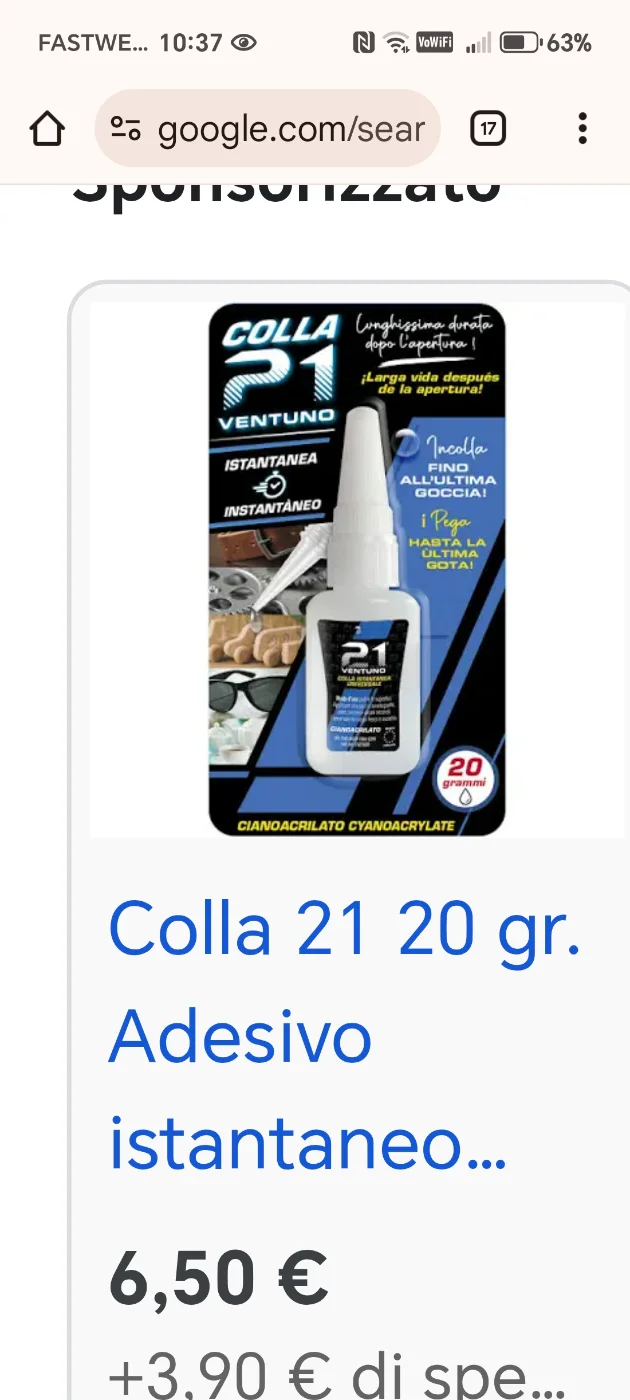
Thanks
Horatio
Well-known member
- Messages
- 2,664
- Reaction score
- 3,536
- Points
- 458
Not sure you've done anything wrong TBH.Hi Horatio, I tried two things: first, I put baking soda in the hole, then I added glue. I waited a day, then I tried drilling the hole, but it all fell apart. Then I tried the opposite: I filled the hole with glue, then I sprinkled it with baking soda, but again, it didn't work. The glue I'm using is called Glue 21, a type of glue they sell here in Italy, a cyanoacrylate. What do you think I'm doing wrong?
Thanks
View attachment 9898
Try a thinner CA - definitely recommend Zap Thin CA.
Aerospace grade CA.
Sandracer_NL
Well-known member
- Messages
- 377
- Reaction score
- 601
- Points
- 293
- Location
- The Netherlands
- Corally RC's
- Kagama
- Muraco
- Radix
- Spark
Do not put in the glue first. Ad soon as the glue and baking soda come in contact, the reaction starts en becomes rock solid; so you won’t get that the bottom of the hole.Hi Horatio, I tried two things: first, I put baking soda in the hole, then I added glue. I waited a day, then I tried drilling the hole, but it all fell apart. Then I tried the opposite: I filled the hole with glue, then I sprinkled it with baking soda, but again, it didn't work. The glue I'm using is called Glue 21, a type of glue they sell here in Italy, a cyanoacrylate. What do you think I'm doing wrong?
Thanks
View attachment 9898
Depending on how deep you want to fill, use multiple layers. Start with baking soda, add glue and repeat.
As Horatio mentioned, using a very thin (liquid) glue is key. You want it as liquid a water. ‘Medium’ thickness glue for RC tires did not work for me; too thick.
Usually the cheapest super glues at low cost stores are very liquid.
Horatio
Well-known member
- Messages
- 2,664
- Reaction score
- 3,536
- Points
- 458
It hardens within seconds.will try to do it in layers so in more steps, however the glue 21 is very liquid I would say perfect for this operation.
how much time must pass before I can start drilling and then threading?
Thanks
When drilling the hole, start with much smaller drills - then work up to 3.3mm. And make sure that they're sharp.
